
Pajero vs Destinator
In fourteen months Mitsubishi launched two three-row, seven-seat SUVs. In July 2025 came the Destinator; on 2 September 2026 came the all-new Pajero. They look like relatives, and buyers are already treating them as alternatives.
The short answer: they are not alternatives. The Pajero is a ladder-frame diesel with a locking centre differential and seven terrain modes. The Destinator is a front-wheel-drive petrol crossover with a CVT. The shared face hides two entirely different machines built for two different jobs.
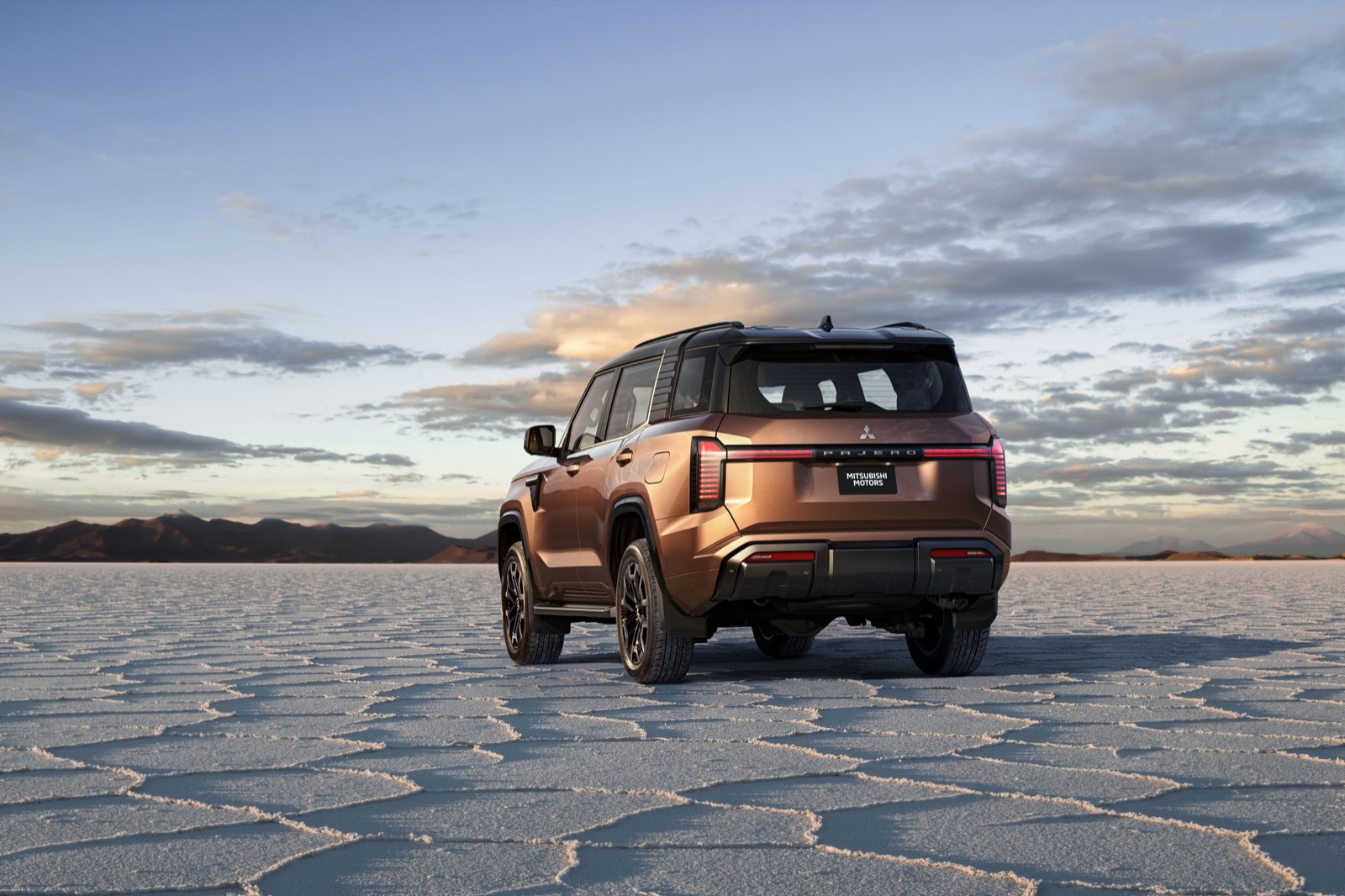
The numbers side by side
| Pajero (2026) | Destinator (2025) | |
|---|---|---|
| Construction | Ladder frame | Monocoque |
| Engine | 2.4 L diesel, VG turbo | 1.5 L turbo petrol |
| Torque | 480 Nm | 250 Nm |
| Power | Not disclosed | 120 kW |
| Transmission | 8-speed automatic | CVT |
| Drive | Super Select 4WD-II + S-AWC | Front-wheel drive |
| Length | 4,920 mm | 4,680 mm |
| Width | 1,925 mm | 1,840 mm |
| Wheelbase | 2,870 mm | 2,815 mm |
| Ground clearance | 230 mm | 214 mm |
| Seats | 7 | 7 |
| Built in | Thailand | Indonesia |
The torque figure is the one to hold onto: 480 Nm against 250 Nm is not a trim-level difference, it is a difference of purpose. So is the drivetrain line. Everything else follows from those two rows.
Where they genuinely differ
The Destinator is a monocoque — body and frame as one structure. That makes it lighter, quieter and better riding on tarmac, and it is the right answer for a family car that will spend its life on sealed roads. It also means there is no separate chassis to take the flex and punishment of repeated off-road use.
The Pajero is body-on-frame, which is heavier and less refined on a motorway but tolerates abuse, towing and sustained rough-road work in a way a crossover does not. Add Super Select 4WD-II — full-time four-wheel drive with a locking centre differential and a low range — and seven terrain modes covering Gravel, Snow, Mud, Sand and Rock, and the intent is unmistakable.
The Destinator's raised clearance and cladding say off-road; its front-wheel drive and CVT say otherwise. That is not a criticism. It is simply a different vehicle wearing a family resemblance, and the resemblance is what confuses people.
The shared design language
What they do share is a styling system, and it is worth naming because it will spread across the range.
- Vertical light signatures front and rear, splitting the lamp into stacked elements rather than a single horizontal bar — the opposite of the full-width light strip most brands adopted.
- Squared shoulders and a flat roof, with the glasshouse sitting upright instead of tapering.
- A horizontal dashboard built around a wide landscape screen, rather than a portrait tablet.
- Short overhangs and a visible, protective lower body edge.
This is Mitsubishi returning to rectilinear design while much of the segment has gone soft-edged. On the Pajero it is functional — those short overhangs produce the 30.4-degree approach angle. On the Destinator the same language is applied for appearance. Same vocabulary, different sentence.
Seven seats, two philosophies
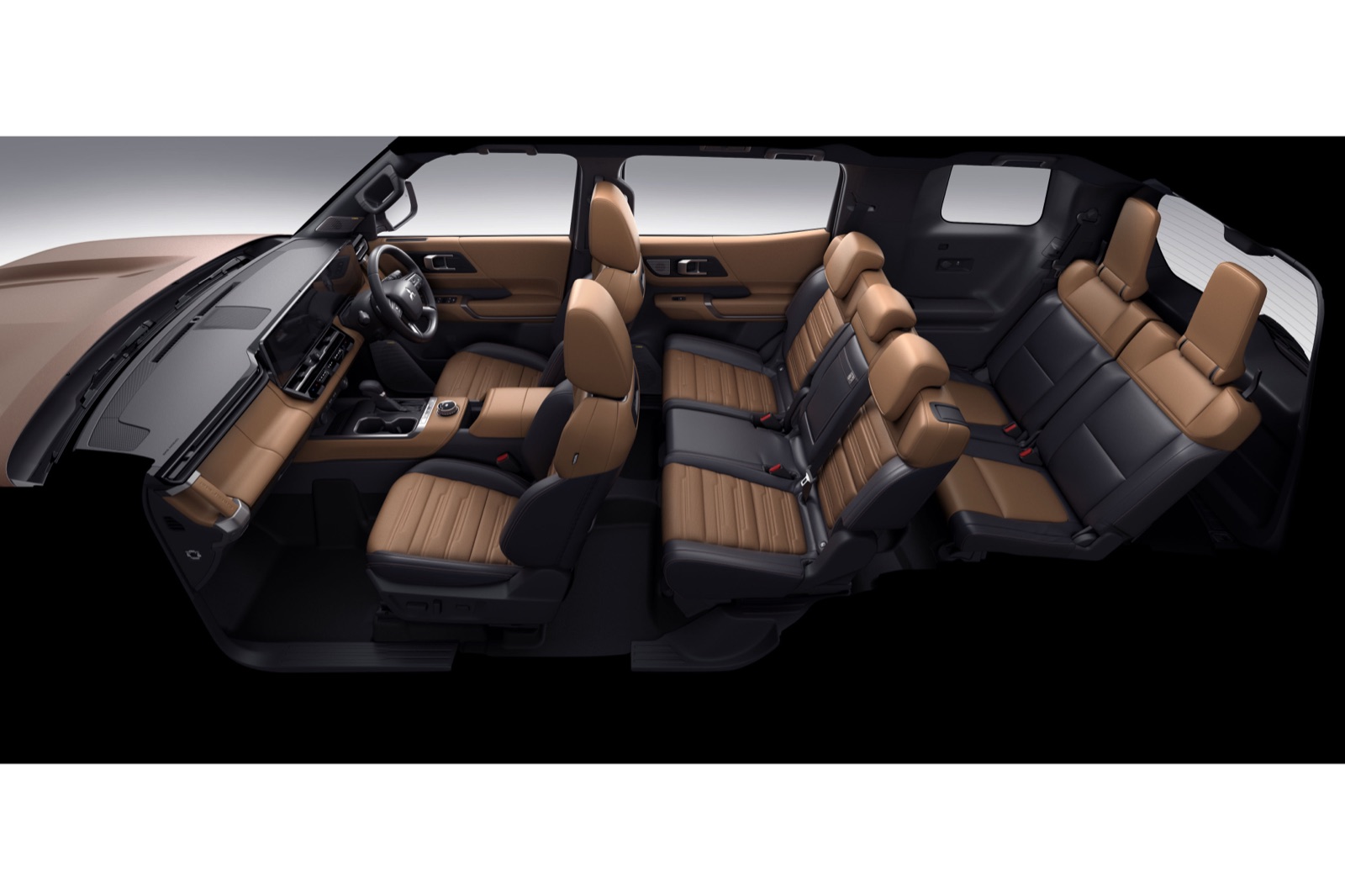
Both carry seven. The difference is what the third row is for. In the Destinator it is a family's occasional-use bench in a car sized for city parking. In the Pajero, with 240 mm more body and 85 mm more width, it is a working row.
The extra width does more than the extra length here. A 1,925 mm body gives genuine shoulder room across the middle row, which is where a seven-seater is actually judged on a long drive.
Which one is for you
Split it by what you will actually do, not by badge.
| If you... | Choose |
|---|---|
| Drive school runs, malls and the occasional highway trip | Destinator |
| Want seven seats on a smaller footprint and lower running costs | Destinator |
| Go into the desert more than twice a year | Pajero |
| Tow, or load heavily and often | Pajero |
| Need the car before 2027 | Destinator, by availability alone |
That last row is not a throwaway. The Destinator is already on sale in several markets; the Pajero does not reach the Middle East until fiscal 2027 at the earliest. For a lot of buyers the comparison resolves itself on timing before it ever reaches engineering — the full Pajero launch timeline and price expectations covers that in detail.
Sources and image credit
Pajero specifications are from Mitsubishi Motors' news release of 2 September 2026, and the photographs are Mitsubishi press images from that release. Destinator specifications and market pricing were read in September 2026 from Cars.co.za and AutoDeal Philippines. Power output for the Pajero has not been disclosed.
Frequently asked questions
What is the difference between the Mitsubishi Pajero and the Destinator?
They share a badge and a seat count and almost nothing else. The Pajero is a ladder-frame, 2.4-litre diesel, full-time four-wheel-drive flagship measuring 4,920 mm. The Destinator is a 4,680 mm monocoque crossover with a 1.5-litre turbo petrol, a CVT and front-wheel drive. One is engineered to leave the road, the other to carry seven people comfortably on it.
Which is bigger, the Pajero or the Destinator?
The Pajero, by a clear margin: 4,920 mm long against 4,680 mm, 1,925 mm wide against 1,840 mm, and a 2,870 mm wheelbase against 2,815 mm. It also has 230 mm of ground clearance versus 214 mm. The gap in width and clearance matters more in practice than the 240 mm of length.
Is the Destinator four-wheel drive?
No. The Destinator sends its 120 kW and 250 Nm to the front axle through a CVT. It has raised ground clearance and the look of an off-roader, but no low range, no locking differential and no rear drive. The Pajero, by contrast, uses Super Select 4WD-II with Super-All Wheel Control and seven terrain modes.
Which one is coming to the UAE?
Both are heading for the Middle East, on different timelines. The Destinator was revealed in July 2025 and has already launched in the Philippines and South Africa, with the Middle East named among its planned markets. The Pajero reaches the Middle East from fiscal 2027 onward, so 2027 at the earliest. The Destinator will almost certainly arrive first.
How much does the Destinator cost?
It is priced by market rather than globally. In the Philippines it runs from ₱1,289,000 for the GLX Turbo CVT to ₱1,799,000 for the GT Turbo; in South Africa from R489,990 to R569,990; in Indonesia between roughly Rp 402 and 517 million. No UAE price has been published, and no price at all has been announced for the Pajero.
Do they share a platform?
No. The Destinator is a monocoque crossover built in Indonesia; the Pajero is body-on-frame and built in Thailand. What they share is design language — the vertical light signature, the squared shoulders and the flat, horizontal dashboard — which is a styling family, not an engineering one.